United Nations
Los pacientes del doctor GarcíaThe United Nations is the arena in which Spanish Republicans seek international action against Franco, but in the novel it becomes a measure of the distance between condemnation and rescue. Its decisions can isolate the regime and preserve a Republican presence in diplomacy; they do not bring about the allied intervention on which resistance inside Spain stakes its hopes. The contrast is central to Manuel Arroyo’s disillusionment and to the defeat of a planned uprising in Madrid.
From diplomatic exclusion to a new forum
In June 1945, at the San Francisco conference that founded the United Nations to replace the League of Nations, Francoist Spain was barred from participation. Republican politicians were invited instead to attend as observers. The exclusion was a striking diplomatic rebuke, but it did not end Spain’s isolation or give the exiled Republic a sovereign role in international affairs. For Manuel, who had spent years doing diplomatic work, the distinction between being heard and possessing influence mattered: the outcome looked like a major success from outside, while he remained distrustful of the assurances and political calculations surrounding it.
That distrust was sharpened by his own position in Geneva. He had once represented a country with territory and sovereignty; now he worked in an international setting where Spain’s absence from official forums did little to alter the conditions he cared about. The novel renders diplomacy not as a simple alternative to force but as a stage on which Republican representatives could be present without being able to compel action. The United Nations offered a venue for their cause, while the practical limits of that venue remained painfully visible.
The forecast of condemnation without intervention
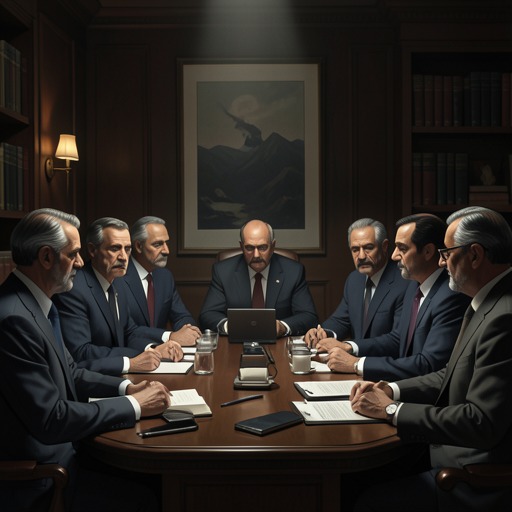
At Taplow on July 27, 1946, Pablo de Azcárate asked Manuel to estimate the chances that the United Nations General Assembly would condemn Franco’s regime. Manuel initially hesitated, then gave a sharply divided assessment: he believed a resolution was likely to pass, but saw almost no chance that it would dislodge Franco from power. His distinction was specific. A majority might agree to a text that neither tightened the economic blockade nor threatened military action, still less an allied invasion of Spain.
Manuel expected member states to declare Franco intolerable and to keep Spain out of the United Nations while he ruled. But, in his analysis, agreement on denunciation would stop short of measures that could change the balance of power. Azcárate and Juan Negrín confirmed that this was also their expectation. The scene presents their shared judgment not as ignorance of diplomatic possibilities but as a sober recognition of their limits: censure could be achieved more readily than intervention.
Manuel connects that limit to the rapid reshaping of the war’s public memory. As the Soviet Union’s role in defeating Hitler receded in the account favored by the Western powers, Franco could present himself as a champion of anti-communism. Manuel also points to the contradiction between the highly publicized Nuremberg trials and reports that Nazis were disappearing from camps and prisons, possibly recruited by Allied authorities for anti-Soviet work. If former Nazis could be useful in the emerging struggle, he reasons, Franco might be useful too. His suspicion is therefore tied to a political shift: the United Nations may condemn the regime, while Cold War priorities reduce the likelihood that condemnation will be backed by action.
A failed uprising built around international expectations
The novel gives that diplomatic gap consequences inside Spain. Young students, apprentices, and working women, many from Republican families but with little political training, enter resistance after the Allied victory in the Second World War. They believe the defeat of the Axis will be followed by Franco’s fall. Their hope is not simply that the United Nations will speak against him; they expect international action to create the opening for a domestic revolt.
In the account of their plans, they listen eagerly to the BBC, make bombs that fail to explode, circulate pamphlets, and recover weapons hidden in family homes. Their intended armed rising is directed at taking Madrid when the United Nations removes Franco from power. On December 12, 1946, that expected opportunity fails to materialize. The young conspirators’ willingness to risk their lives meets not the decisive international intervention they anticipated but its absence. Their struggle does not immediately end, yet the political premise on which they had imagined victory has collapsed.
Manuel encounters the human cost of that collapse through Ramón Mateos and the group of young men preparing to seize the Palace of Communications at the Cibeles roundabout. Ramón is a third-year industrial engineering student, an orphan whose brother died at Brunete and whose other brother is serving a penal sentence; his sister works as a cleaner by the hour so he can study. He also holds a Francoist scholarship, granted for his exceptional academic record and through a maternal uncle who served as a military chaplain for the victorious army. He and the other students form part of an assault group awaiting an intervention by the United Nations in favor of Spanish democrats. When Manuel sees that they already know the news he had feared delivering, he feels both relief and heartbreak. The diplomatic failure is thus registered not only in political forecasts but in the faces of young people whose plans have depended on a promise the international community never made good.
A limited resolution, and a lasting record
In October 1947, the Allied Control Council in Spain submits a list of 104 names to the government in Madrid. The document, eleven typewritten pages in English, concerns people linked to Nazi activity in Spain as well as prominent collaborators from occupied countries, some accused of crimes against humanity. The list belongs to a sustained effort to secure Spanish cooperation: for more than two years, the Allies have repeatedly asked the regime to help locate and surrender such people, with little result. Its delivery shows that Allied authorities can make demands through diplomatic channels; the history surrounding the list also underlines how often those demands fail to produce cooperation.
The novel’s treatment of the United Nations therefore distinguishes formal action from effective protection. Excluding Francoist Spain from participation, inviting Republican observers, discussing condemnation, and pressing Madrid over wanted collaborators are consequential acts, but none amounts to removing Franco or dismantling the protection afforded to fugitives. Manuel’s later handling of intelligence about the Nazi network makes the same vulnerability personal. He fears that his reports, dependent on a response from Washington, will not be used while he remains alive in Spain; monitoring him at a distance is safer for those with power than openly exposing the operation. He sends a letter to Azcárate at the United Nations’ Palestine Commission offices in New York, but he understands that the sale of Nazi loot is shielded by the same political protection as the war criminals Franco shelters.
The book finally places Republican diplomacy within a longer chain of political choices. Its author notes that, historically, the exiles’ diplomatic effort concentrated above all on the United Nations declaration of December 1946; the novel extends that effort further while maintaining the distinction between historical truth and literary plausibility. In the story, the institution remains a real point of appeal, but not a deliverer. Its censure and exclusions give the Republicans a public platform; the failure to turn them into intervention leaves the regime in place and transforms hope into a record of abandonment.